Selling in the Age of AI
Parul Mishra on AI, the changing art of sales from product-pushing to problem-solving, and why adaptability may be the most valuable career skill of all.
For students thinking about careers in business or sales, the word sales can still sound old-fashioned — cold calls, pitches, and pressure to “close the deal.” But according to Ms. Parul Mishra, Vice President of Global Technology Sales for Agentic AI at IBM, that picture is already outdated.
After more than two decades at IBM, Mishra has seen technology and the role of sales professionals transform completely. Today, she says, AI isn’t just changing what gets sold. It’s changing who succeeds in sales, how they work, and what skills matter most.

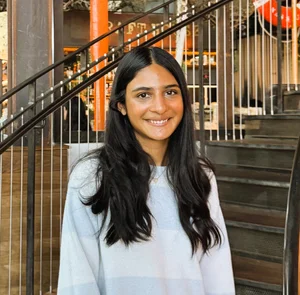
Parul Mishra, Vice President of Global Technology Sales, IBM (Photo courtesy of Ms. Mishra)
From Chatbots to AI That Actually Gets Things Done
Mishra begins by drawing a clear line between earlier forms of AI and what’s coming next.
“We’re moving from AI that can answer questions to agentic AI — where AI can actually do things for you”
Most people are familiar with chatbots like ChatGPT: you ask a question, you get a response. Agentic AI goes further. It can take action — summarize information, complete tasks, and act like a real assistant rather than a search tool.
“Think of it as having an assistant that doesn’t just answer questions, but actually goes and does the work for you,” she said.
For businesses, this shift dramatically increases the value of AI. And for professionals, it changes how work gets done — especially in sales.
Why the “Art of Sales” Is Changing
Mishra described how sales used to work: sell the product, emphasize features, and convince the customer it’s the best option.
That approach no longer works.
“Customers are saying, ‘I have a problem, and you need to help me solve that problem,’ they want a partner, not just someone pushing a product.”
In technology sales, especially, clients expect sellers to understand:
How fast technology is evolving
What’s happening across the industry
How different tools fit together
and how all of it applies to their specific challenge
This means sales roles are becoming more strategic and more technical — even for people who don’t write code.
How AI Helps Salespeople Do the Job Better
One of the most practical ways Mishra uses AI is for personal productivity.
“Sometimes I don’t have time to read five dense technical papers a day,” she said. “So I’ll ask AI to summarize them into key takeaways.”
Instead of spending hours on background research, she can stay informed quickly — and focus her energy on conversations with customers.
AI also helps with the least-loved part of sales: paperwork.
“Sales teams spend a lot of time recording meetings, updating systems, and summarizing discussions,” she explained. “AI can take over that grunt work.”
By delegating documentation and summarization to AI, sellers get back what matters most: time to think, learn, and talk to customers.
Will AI Take Sales Jobs? Her Answer Is Clear
Mishra addressed a concern many students have directly: Will AI replace me?
Her answer: no — but it will separate those who adapt from those who don’t.
“People who understand how AI works will 100% differentiate themselves from those who are afraid of it or don’t want to learn it”
She emphasized that students don’t need to become coders to succeed. AI has become democratized — meaning anyone who uses tools like ChatGPT is already engaging with it.
What matters is how people use it.
“People who find smart ways to leverage AI to be more productive, more knowledgeable, and more effective will benefit — no matter what job they choose.”
A Career Built on Versatility, Not a Straight Line
Over her 21-year career at IBM, Mishra has held more than a dozen different roles — from software engineering to operations, finance, product development, and now global sales.
Early on, she worried that her career path lacked focus.
“I wondered if all these different roles would ever add up to something meaningful,” she said.
Looking back, she sees the opposite.
Those experiences helped her connect dots others couldn’t — understanding both internal operations and customer-facing challenges.
“There’s a lot of value in doing different roles,” she said. “It makes you more well-rounded and better at problem-solving.”
Her advice to students is simple but counterintuitive:
“Don’t chase titles. Chase personal growth.”
Growth, she said, doesn’t come from comfort.
“If you want to grow, you have to take roles that make you uncomfortable.”
Responsible AI
While Mishra is optimistic about AI, she’s also realistic about its risks.
“We shouldn’t just focus on what AI can do — but what it should do,” she said.
As AI systems become more autonomous, questions around trust, accountability, security, and data privacy become critical — especially for enterprises handling sensitive information.
Her message to students entering this field: excitement should be balanced with responsibility.
Fast Five with Ms. Parul Mishra
To wrap up, I asked Ms. Mishra a few rapid-fire questions:
What did you want to be when you were a kid?
A pilot — she’s still fascinated by aviation and navigation.
What’s one task you’d gladly let AI do?
Managing emails.
What’s something humans will always do better than AI?
Emotional connection and real empathy.
What’s the last thing you asked AI?
To summarize a highly technical white paper before an early-morning meeting.
What’s one job you’d never trust AI to do?
Relationships.
The Big Takeaway
For students considering careers in business, sales, or technology, Mishra’s message is reassuring — and challenging.
AI isn’t here to replace professionals. It’s here to raise the bar.
The future belongs to people who:
stay curious
learn continuously
embrace change
and use AI as a partner, not a crutch
In a world where technology keeps accelerating, adaptability may be the most valuable skill of all.