Before AI Gives Us the Answer
California Assemblymember Dr. Darshana Patel on education, critical thinking, and preparing students for a future no one can predict.
Artificial intelligence is moving faster than almost any education system can keep up.
Teachers are figuring out how students can use it responsibly. Students are embracing it. Parents are wondering whether AI is becoming the next thing they need to worry about, much like social media before it.
And policymakers are faced with an equally difficult question: How do you prepare students for a future that nobody can fully predict?
Few people have a more unique vantage point on that question than California Assemblymember Dr. Darshana Patel.
Before serving in the California Legislature, Patel was a research scientist. She later served on the Poway Unified School District Board, where she helped oversee one of California’s largest public school systems. Today, she helps shape education policy for a state that educates nearly six million students.
That combination of experiences makes her perspective especially compelling. She understands how scientists solve problems, how classrooms actually operate, and how public policy can either enable or unintentionally hinder the next generation of learning.
I knew we would talk about AI, and we did. But also, our conversation became something much bigger.
It became a conversation about how we protect curiosity, creativity, and critical thinking in a world where answers have never been easier to generate.
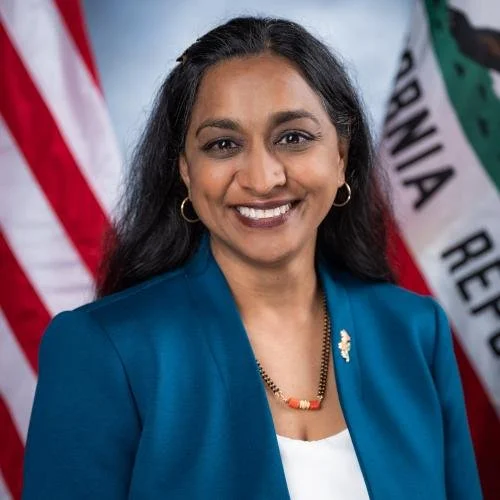
Dr. Darshana Patel, California Assemblymember, District 76 (Photo courtesy of Dr. Patel)
When AI Starts Thinking for Us
One phrase came up repeatedly throughout our conversation:
Cognitive offloading.
Patel worries that, as AI becomes more capable, students may gradually begin outsourcing not just their homework, but their thinking.
She explained it in a way that immediately clicked.
Every student brings something unique into the classroom. Conversations with family. Experiences with friends. Cultural background. Personal struggles. Things they’ve observed in their community. Those experiences become part of how they write, solve problems, and create ideas.
AI can certainly generate content.
But it didn’t live your life.
“It’s not only cognitive offloading… it’s also cultural offloading.”
That second phrase really stood out to me.
Patel wasn’t simply talking about students letting AI write essays.
She was talking about what happens if we slowly stop bringing our unique perspectives into the work.
That matters because many of the problems today’s students will inherit won’t have obvious answers.
Years ago, while serving on a community planning board, Patel learned about something called a “wicked problem.” These are problems with no clear win-win solution, or problems where you can’t simply test every option before acting.
Climate change.
Housing.
Public health.
Education itself.
These are the kinds of problems that demand creativity, empathy, judgment, and diverse ways of thinking.
If we lose the habit of thinking deeply ourselves, Patel worries we may struggle with something even more fundamental: figuring out what problem we’re actually trying to solve.
That idea naturally led to one of my favorite quotes from the interview.
“Critical thinking isn’t just about finding the right answer. It’s actually about knowing what the right question is.”
As someone who spent years in scientific research, Patel learned that discoveries rarely begin with answers.
They begin with good questions.
And sometimes those questions don’t come from Google or ChatGPT.
They come from talking with people.
Listening to communities.
Paying attention to experiences that no language model has ever lived.
The Teacher-Student relationship
When I asked Patel what she thought would remain fundamentally human about education, she remembered one of her college calculus professors.
Long before AI existed, he refused to let students use calculators in class. His point wasn’t that calculators were bad, but that students first needed to develop the mathematical foundation.
Technology will continue to evolve.
The heart of education shouldn’t.
“The heart of education… is the relationship between the teacher and the student.”
A great teacher can tell when a student is struggling long before they raise their hand. They notice the furrowed brow, the hesitant pause, the moment confusion starts to set in. Just as importantly, they know when to challenge a student, when to encourage them, and when to explain an idea a different way.
AI doesn’t see you struggle like that. Teaching is more than delivering information. It’s responding to how someone is learning in the moment.
Technology can make learning more accessible. But Patel believes those human relationships remain the foundation of great education, because ultimately learning is about being seen, supported, and challenged by someone who recognizes your potential.
Preparing Students for a Future Nobody Can Predict
Imagine a student entering kindergarten today and graduating high school in 2039.
What should their education actually look like?
Patel smiled before answering.
Because the honest answer is…
nobody knows.
Education has always evolved.
Standards change.
Curriculum changes.
Teaching methods change.
AI is accelerating that pace.
So instead of trying to predict every future technology, Patel believes schools should invest in the qualities that have always mattered.
Critical thinking.
Problem solving.
Resilience.
Human connection.
Those are the skills she believes will continue serving students no matter how technology evolves.
Interestingly, she also expects education to become less screen-centric in some ways.
She pointed to growing concerns around screen time and imagined schools placing renewed emphasis on outdoor learning, project-based learning, collaborative work, and hands-on experiences.
That isn’t a rejection of technology.
It’s a recognition that students need opportunities to develop the very human skills technology can’t develop for them.
AI Literacy Is About More Than Learning ChatGPT
If there’s one area where Patel believes schools need to move quickly, it’s AI literacy.
But she doesn’t define AI literacy as simply learning how to write better prompts.
It’s much broader than that.
Students need to understand what AI is.
How it works.
When it’s helpful.
And just as importantly — what they’re giving up when they use it.
One example she brought up surprised me.
When young people post ideas, artwork, writing, or creative projects online, many don’t realize they’re also contributing their own intellectual property.
“Their thoughts are their ideas, and that’s their value.”
For Patel, AI literacy isn’t just a technical skill.
It’s understanding privacy.
Ownership.
Digital citizenship.
Knowing when a tool is helping you learn — and when it’s quietly replacing the learning itself.
She also sees AI literacy as an issue of equity.
Schools have already navigated unequal access to computers and internet connectivity. AI could create similar divides if some students learn how to use these tools thoughtfully while others are left figuring them out on their own.
Sometimes the Best Learning Comes From Getting It Wrong
The most memorable part of our conversation came near the very end.
I asked Patel what lessons from her own career students should carry into an AI-driven future.
She didn’t talk about legislation.
Or technology.
She talked about failure.
As a graduate student, she failed.
Not once.
Not twice.
Four different research projects failed before she finally found the dissertation topic that worked.
Looking back, she doesn’t see those years as setbacks.
She sees them as some of the most valuable education she ever received.
Failure taught her when to keep going.
It taught her when to recognize that something wasn’t working.
It taught her when to cut her losses and try a different approach.
Those lessons became far more valuable than simply getting the “right answer.”
And that’s why she worries about students letting AI do too much of the work.
Her analogy couldn’t have been more relatable.
Imagine you’re assigned a group project.
Every group has that one student who quietly sits in the back while someone else does the planning, the research, and the presentation.
When the project is over, everyone gets the same grade.
Everyone reaches the same destination.
But only the student who actually drove the project understands the journey.
“Using AI can be like being part of a group assignment where you’re kind of the back-seater and not the driver. Over-reliance means you don’t own that learning”
That’s the difference Patel hopes students remember.
Learning isn’t just about producing an assignment.
It’s about wrestling with ideas long enough that they become your own.
That struggle and discomfort, is often where understanding actually develops.
One Last Thing She Wanted Students to Hear
After we had wrapped up the interview, Patel paused.
There was one more thought she wanted to leave with students.
It wasn’t about AI.
It wasn’t about education policy.
It was about life.
She said she hopes young people never view one mistake as defining who they are.
“If something goes wrong, it’s not a single-point failure in your life.”
She encouraged students not to chase perfection.
To enjoy the journey.
To recognize that some of the most meaningful growth comes from the moments that don’t go according to plan.
As someone who has moved from scientific research to local education leadership and now to the California Legislature, she has seen firsthand how often progress comes from iteration rather than perfection.
Perhaps that’s the deeper lesson from our conversation.
AI will continue changing how we learn.
Schools will continue adapting.
Technology will continue evolving.
But education has never been just about producing answers.
It’s about developing people who know how to ask thoughtful questions, wrestle with difficult problems, learn from failure, and bring their own perspective to challenges that no machine has ever experienced.