When AI Joins the Lab Coat Crew
Dr. Smita Paranjape on AI and the future of research
When I first read about Dr. Smita Paranjape, I thought: “Wow. She’s literally doing science that sounds like sci-fi.” Dr. Paranjape holds a Ph.D. in Cellular and Molecular Biology from the University of Kansas and has spent over a decade conducting postdoctoral research in neuroscience and molecular biology, primarily at the University of North Carolina at Chapel Hill. As a senior research scientist in the biopharma space, she has worked as a Cell Line Developer Scientist, engineering living cells to produce life-saving biologics like vaccines and cancer therapies. Think of it as programming living systems to produce medicine. And now, artificial intelligence (AI) is stepping into the lab.
I got the chance to talk to Dr. Paranjape about her work, how AI is changing the landscape of biotech, and what students should be thinking about if we’re considering careers in science. Here’s what I learned.
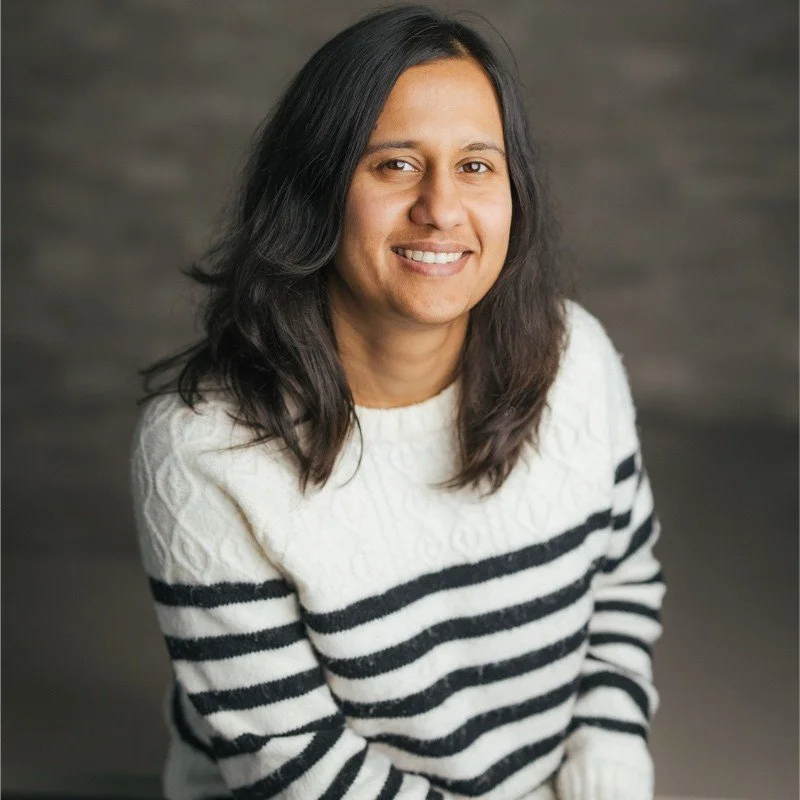
Dr. Smita Paranjape, Ph.D., Molecular and Cellular biologist. (Photo courtesy of Dr. Paranjape)
What Does a Cell Line Developer Scientist Actually Do?
Dr. Paranjape explained her role in simple terms. She works in cell line development. Basically, she adds DNA instructions into cells so that they start producing specific proteins – like antibodies used in cancer treatment. These proteins are harvested, purified, and eventually become medicines that help real people.
“So, what I do every day is basically engineering the cells to make whatever product is required,” she said.
It's not just mixing stuff in beakers – it's highly technical and precise work that involves understanding how DNA, RNA, and proteins interact in complex ways. It also means making sure that the process is reproducible and scalable – what scientists call taking a discovery “from bench to bedside.”
Enter AI: From Tedious to Thoughtful
One of the most interesting parts of our conversation was hearing how AI has started to shift what lab life looks like. Dr. Paranjape described how tasks that used to take hours – like screening thousands of culture plates to find the most productive clone – can now be automated with AI.
“We now have machines that can scan through hundreds of culture plates to identify single-cell clones or the highest-producing lines. This kind of automation has freed up our time to focus on more strategic thinking, experimental design, and solving complex research problems”
It’s not just about efficiency – it’s about changing the kind of work scientists focus on. Instead of doing repetitive manual tasks, researchers can now spend more time designing better experiments, interpreting results, and solving real problems.
Precision, Patterns, and Pitfalls
In fields like molecular biology, reproducibility is everything. If a result can’t be replicated, it might not be reliable. Dr. Paranjape said AI and automation are actually helping with that too.
“Initially, we would say that one experiment done by one person can be different from the same experiment done by someone else. That kind of discrepancy is now gone.”
AI also helps in identifying patterns that humans might miss, especially when you're dealing with thousands of data points. For example, the bioinformatics team at her lab uses AI to correlate variables like temperature or nutrients with how much protein the cells produce. It’s like letting a superpowered detective look through your clues and find hidden connections.
Still, Dr. Paranjape noted that programming AI tools to handle complex biological data takes time. It’s powerful, but not magic.
What AI Can’t Do (Yet)
Despite all the automation, there are things AI can’t quite do yet – like inventing completely new experiments or coming up with creative scientific questions.
Dr. Paranjape explained that in her work, designing a new assay to investigate how a gene functions in a disease isn't just about analyzing past data – it requires drawing connections across disciplines like genetics, cell biology, and biochemistry, and thinking in genuinely new ways. “That is typically what research is,” she said. “So, I feel in that sense, original thinking is something students should focus on.”
While AI can generate novel outputs by remixing existing information, its “creativity” is fundamentally based on recognizing patterns and optimizing for known outcomes. In contrast, a research scientist’s creativity is shaped by curiosity, intuition, and the ability to ask questions that haven’t been asked before – often rooted in human experiences, and a deeper understanding of context. That kind of originality, sparked by insight rather than data, remains a distinctly human skill so far – and one that's essential for true innovation in science.
Ethics and Information Overload
When I asked about ethical concerns, Dr. Paranjape offered a warning I didn’t expect: not about AI taking over jobs, but about students blindly trusting AI-generated information.
“It would be naive to just believe that answer as it is,” she said, referring to online AI tools. “You always have to verify what information you get before you use it.”
This is especially important in science, where bad data can lead to wasted time… or worse. As she put it, the true data is still in research publications, not search results.
Fast Five
To wrap up, I asked Dr. Paranjape five quick questions.
What did you want to be as a kid? “A pilot.”
One task you’d gladly let AI handle? “Counting and screening cells”
What will humans always do better? “Original, creative thinking.”
Last thing you asked AI? And, to which AI? “Chat GPT; Help with research on transfection conditions.”
One job you’d never trust AI with? “Taking care of my kids!”
Advice for Future Scientists
If you’re a student thinking about neuroscience, biotech, or any science career, here’s Dr. Paranjape’s advice:
“Figure out early whether you want to go into academia or industry. Also, develop an interest in problem solving. If you enjoy that, then research is for you.”
I left this interview with a different perspective on what a career in science can look like. As AI takes on more of the repetitive work, it gives scientists more room to focus on the parts that matter most: asking better questions, thinking creatively, and solving problems that don’t have obvious answers. If anything, my conversation with Dr. Paranjape made me more excited about where science is headed, and the role people will continue to play in shaping it.